Canna Bengal Tiger (Rhizomes)
Pretoria Variegated Canna Lily
Family
Origin
India, Africa
Description
Cannas are vibrant tender perennials that produce bold leaves and showy flowers in shades of red, orange, yellows and pinks. The tall or dwarf foliage displays spirally arranged leaves that may be green or bronze.
The flowers are somewhat similar to an iris in shape. Their huge leaves wrap in ruffles around stems, tapering to refined buds that open into large, rainbow-hued flowers all summer long even in intense heat. Sometimes spotted variations of the scarlet, red-orange, or yellow flowers occur.
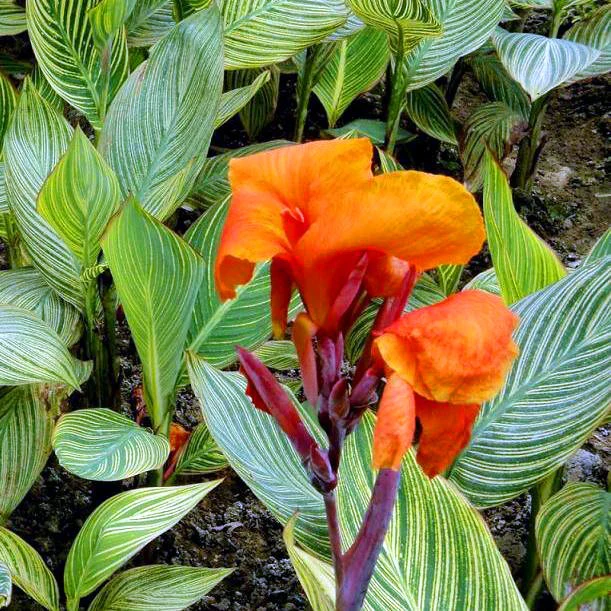
Canna 'Bengal Tiger' is considered by many to be the most beautiful of canna lilies. The dramatic stalks of green- and yellow-striped variegated leaves with a brilliant maroon edge grow to 6' and are topped in summer with bright orange flowers that are favored by hummingbirds.
Canna Bengal Tiger displays bold green and yellow striped leaves complemented by vibrant orange flowers. Its blooming period extends from June to October in plains and July to November in hilly areas. For a tropical summer effect, plant rhizomes between February and April or March and May.
Environment
Cannas need full sun for good flowering and consistently moist soil with a pH of around 6.0-6.5. Add lime before planting if your garden soil is acidic (low pH). Position plants away from strong wind; their large, soft leaves are vulnerable to damage.
Cannas can not tolerate cold temperatures. Soil must be 60ºF or warmer before planting rhizomes. Dig a hole 2 inches deep and set the rhizome 1 to 2 inches below the soil with the “eyes” (bumps or nodes, which are growth sprouts) pointed up. Space rhizomes 1-1/2 to 2 feet apart to give cannas enough room. Containers need to be at least 18 inches in diameter (per rhizome). Before planting, loosen the soil to a depth of 1 foot, then mix in 2 to 4 inches of compost.
Water thoroughly, then withhold water for as long as 3 weeks, and watch for signs of growth. Cannas are slow to sprout. Once sprouted, water at least once a week by slowly soaking the area around the roots.
Full foliage color develops when days are warmer (59ºF or more). Blooms should appear in 10 to 12 weeks.
Use slow-release fertilizer at planting and twice during the growing season. Fish emulsion fertilizer, which is a little higher in nitrogen, is a beneficial organic alternative. Higher nitrogen fertilizers tend to increase canna height.
Landscape Use
Cannas can be both focal points and stylish accents. Use them to bring structure as a tall border or to add depth to narrow spaces. They add a colorful splash to garden orders and poolside plantings. Mix cannas with grasses, lantana, zinnias, snapdragons, elephant ears, salvia, periwinkles, and more.
Original: $2.65
-70%$2.65
$0.79Product Information
Product Information
Shipping & Returns
Shipping & Returns
Description
Pretoria Variegated Canna Lily
Family
Origin
India, Africa
Description
Cannas are vibrant tender perennials that produce bold leaves and showy flowers in shades of red, orange, yellows and pinks. The tall or dwarf foliage displays spirally arranged leaves that may be green or bronze.
The flowers are somewhat similar to an iris in shape. Their huge leaves wrap in ruffles around stems, tapering to refined buds that open into large, rainbow-hued flowers all summer long even in intense heat. Sometimes spotted variations of the scarlet, red-orange, or yellow flowers occur.
Canna 'Bengal Tiger' is considered by many to be the most beautiful of canna lilies. The dramatic stalks of green- and yellow-striped variegated leaves with a brilliant maroon edge grow to 6' and are topped in summer with bright orange flowers that are favored by hummingbirds.
Canna Bengal Tiger displays bold green and yellow striped leaves complemented by vibrant orange flowers. Its blooming period extends from June to October in plains and July to November in hilly areas. For a tropical summer effect, plant rhizomes between February and April or March and May.
Environment
Cannas need full sun for good flowering and consistently moist soil with a pH of around 6.0-6.5. Add lime before planting if your garden soil is acidic (low pH). Position plants away from strong wind; their large, soft leaves are vulnerable to damage.
Cannas can not tolerate cold temperatures. Soil must be 60ºF or warmer before planting rhizomes. Dig a hole 2 inches deep and set the rhizome 1 to 2 inches below the soil with the “eyes” (bumps or nodes, which are growth sprouts) pointed up. Space rhizomes 1-1/2 to 2 feet apart to give cannas enough room. Containers need to be at least 18 inches in diameter (per rhizome). Before planting, loosen the soil to a depth of 1 foot, then mix in 2 to 4 inches of compost.
Water thoroughly, then withhold water for as long as 3 weeks, and watch for signs of growth. Cannas are slow to sprout. Once sprouted, water at least once a week by slowly soaking the area around the roots.
Full foliage color develops when days are warmer (59ºF or more). Blooms should appear in 10 to 12 weeks.
Use slow-release fertilizer at planting and twice during the growing season. Fish emulsion fertilizer, which is a little higher in nitrogen, is a beneficial organic alternative. Higher nitrogen fertilizers tend to increase canna height.
Landscape Use
Cannas can be both focal points and stylish accents. Use them to bring structure as a tall border or to add depth to narrow spaces. They add a colorful splash to garden orders and poolside plantings. Mix cannas with grasses, lantana, zinnias, snapdragons, elephant ears, salvia, periwinkles, and more.