Rajnigandha Polianthes Tuberosa Double Petal (Bulbs)
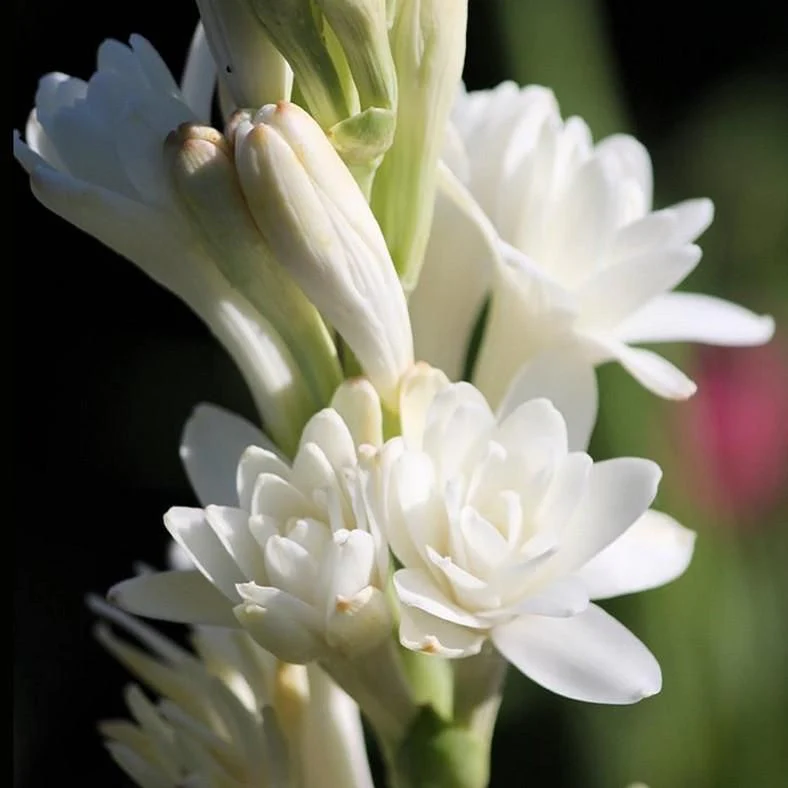
Double Petal White Rajnigandha (The Pearl)
Family
Asparagaceae
Origin
Mexico
Description
Tuberose, (Polianthes tuberosa) is a perennial tuber or tuberous roots of the asparagus family. The tuberose has long bright green leaves , about 1–1.5 ft long and up to 13 mm wide , clustered at the base and smaller clasping leaves along the stem.
The inflorescence is a spike, reaching up to 3 ft high, with pure white waxy flowers. The flowers are tubular, with a tube up to 2.5 in long, separating into six flaring segments (tepals) at the end, and are strongly fragrant and bloom at night. . There are six stamens, inserted into the tube of the flower, and a three-part stigma.
Rajnigandha Double Petal bulbs are prized for their intensely perfumed, fully double white flowers ideal for commercial floristry applications. Each bloom reaches 4-6cm in diameter, borne on robust upright stems extending to 1.2 meters with narrow, elongated leaves. The plant produces concentrated flower spikes that perform reliably across diverse climates—flowering from July through October in plains and August through November in hill stations. Plant bulbs between February and April in lowland zones or March through May in mountainous regions to establish strong root systems and ensure consistent, prolific flowering throughout the designated season.
Environment
Tuberose are best planted in a sunny location. The require full sunlight to bloom.
Well drained loamy soil having a pH of 6.5-7.5 is ideal for the plant. Plant the bulbs in the fall, placing bulbs 3 to 4 inches deep and 2 inches apart in any well-drained soil will produce good results. Tuberose flower in mid to late summer, typically 90-120 days after planting.
Tuberose require rest during winter period in order to bloom in summers.
Tuberose plants are heavy feeders and appreciate applications of 8-8-8 fertilizer while they are actively growing.
The plants benefit from bone meal applied at planting and after blooming. Reduce watering after the foliage begins to die back.
Landscape Use
Tuberoses make a really nice cut flower to scent a room with, or enjoy in pots too.
Product Information
Product Information
Shipping & Returns
Shipping & Returns
Description
Double Petal White Rajnigandha (The Pearl)
Family
Asparagaceae
Origin
Mexico
Description
Tuberose, (Polianthes tuberosa) is a perennial tuber or tuberous roots of the asparagus family. The tuberose has long bright green leaves , about 1–1.5 ft long and up to 13 mm wide , clustered at the base and smaller clasping leaves along the stem.
The inflorescence is a spike, reaching up to 3 ft high, with pure white waxy flowers. The flowers are tubular, with a tube up to 2.5 in long, separating into six flaring segments (tepals) at the end, and are strongly fragrant and bloom at night. . There are six stamens, inserted into the tube of the flower, and a three-part stigma.
Rajnigandha Double Petal bulbs are prized for their intensely perfumed, fully double white flowers ideal for commercial floristry applications. Each bloom reaches 4-6cm in diameter, borne on robust upright stems extending to 1.2 meters with narrow, elongated leaves. The plant produces concentrated flower spikes that perform reliably across diverse climates—flowering from July through October in plains and August through November in hill stations. Plant bulbs between February and April in lowland zones or March through May in mountainous regions to establish strong root systems and ensure consistent, prolific flowering throughout the designated season.
Environment
Tuberose are best planted in a sunny location. The require full sunlight to bloom.
Well drained loamy soil having a pH of 6.5-7.5 is ideal for the plant. Plant the bulbs in the fall, placing bulbs 3 to 4 inches deep and 2 inches apart in any well-drained soil will produce good results. Tuberose flower in mid to late summer, typically 90-120 days after planting.
Tuberose require rest during winter period in order to bloom in summers.
Tuberose plants are heavy feeders and appreciate applications of 8-8-8 fertilizer while they are actively growing.
The plants benefit from bone meal applied at planting and after blooming. Reduce watering after the foliage begins to die back.
Landscape Use
Tuberoses make a really nice cut flower to scent a room with, or enjoy in pots too.